
247paintings
The problem.
Handling large volumes of art requires unique titles, descriptions, and tags. Writing these manually is slow, inconsistent, and highly dependent on individual artists' copywriting skills. Poor descriptions lead to weak SEO, lower conversion rates, and difficult moderation. Ultimately, the publishing process—not the creative work—became the primary bottleneck for artists.
What we built.
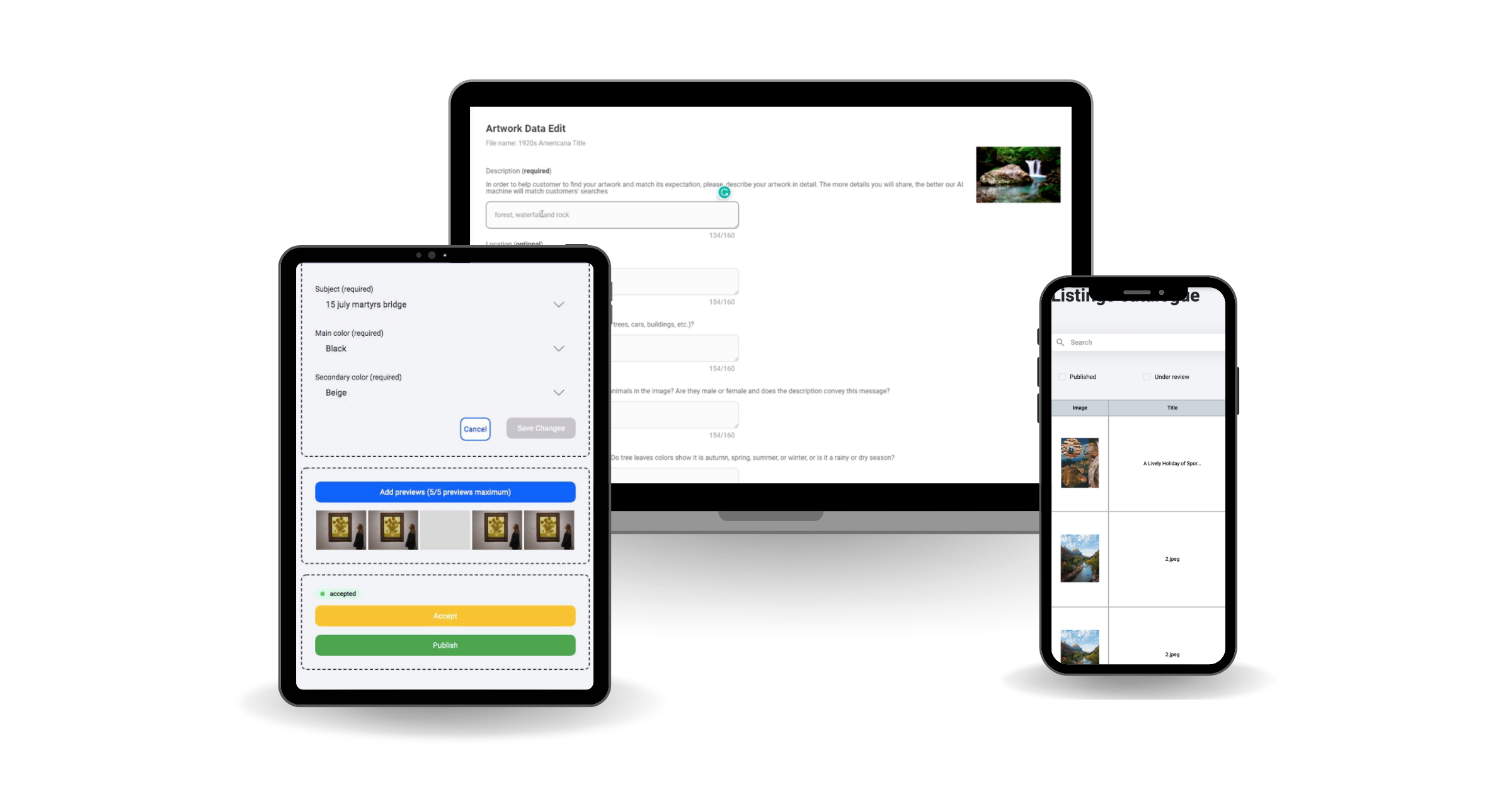
We developed a managed three-step workflow. The artist describes their work using a guided attribute checklist: location, objects, count, gender, colors, emotions, message, and origin. The system then generates a title, short and long descriptions, and tags—strictly adhering to character limits per field—before sending the result for art-director review. Users cannot edit the AI-generated text directly; they must regenerate it, which ensures absolute consistency across the entire catalog.
- Structured input naturally trains the user to provide a highly usable brief for the AI model
- Every field serves a specific purpose: titles for SEO and clicks, short descriptions as teasers, long descriptions for depth, and tags for searchability
- Titles and descriptions are not directly editable, eliminating drift and maintaining catalog consistency
- Generation is isolated as a separate step, ensuring the core publishing flow never breaks
- Preview limits effectively control both content quality and API expenses
The hard part.
The project also navigated the transition from 'it works' to 'it works flawlessly for thousands of users'. We optimized slow page loads in an image-heavy admin panel, implemented ubiquitous thumbnails, and enabled asynchronous uploading, generation, and saving. Furthermore, we introduced a state machine for artwork statuses, moved prompt templates from hardcode to easily editable configurations, built role-based rendering for art directors and admins, and implemented case-insensitive search driven by UX needs rather than default database behavior.
What changed.
- Publishing time per artwork was drastically reduced
- Achieved significantly higher SEO quality alongside a standardized catalog
- Decreased the operational load on art directors per published piece
- Equipped the marketplace to scale its content output without needing to scale the team